Wednesday, July 2, 2008

Solar's Journey to the West

This post was originally published on The Green Leap Forward on Jun 17, 2008.

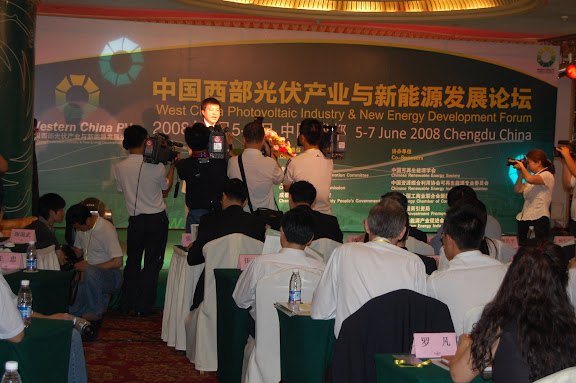
I attended the inaugural Western China Photovoltaic Industry & New Energy Development Forum which was held in the city of Chengdu, Sichuan province earlier this month (June 5-7).

A full transcript in Chinese of the proceedings is available here.

A recurring theme was the need to develop China’s domestic PV market. Although China is among the largest producers of solar photovoltaic (PV) cells in the world, over 90% of such PV cells are exported, leading Shi Dinghuan (石定寰), causing the Chairman of the Chinese Renewable Energy Industries Association (CREIA) to lament that China ships out its clean energy only to leave pollution (i.e. coal fired power generation) behind. At the end of last year, just 80 MW of solar PV was installed in China compared to almost 6,000 MW of wind energy. But more on this paradox later. Let's first see how Chengdu (成都)and Shuangliu (双流) in Sichuan province are seeking to leapfrog Jiangsu province and Baoding (in Hebei province) as the solar PV manufacturing hubs of China.
Sichuan: the Solar Gateway to the West

Sichuan is pushing solar as its next pillar industry. The governments of Chengdu and Shuangliu have established the Chengdu/Shuangliu Photovoltaic Industrial Park. The goal is to turn the region into a “Western Solar Valley” (“西部光谷”) and achieve RMB 100 billion in annual output. On the first day of the conference, some 17 agreements amounting to RMB 14.5 billion in investments into the Solar Valley were penned.

China has abundant solar resources, with solar irradiation comparable to areas of corresponding latitudes in the US, and comparing favorably over areas of corresponding latitudes in Japan and Europe (click here for Greenpeace’s China Solar PV Report 2007). Tibet, in particular, boasts the best solar irradiance of all of China, in part due to its elevated altitudes which greatly reduces irradiance diffusion. The development of a vibrant solar industry in the western regions is also consistent with the national “Go West” policy of developing China’s interior western and remote regions that have traditionally lagged behind the coastal economies. Incidentally, it is these very western remote regions that are homes to a significant portion of the estimated 15 million people in 2006 with no access to electricity. Distributed energy solutions such as solar PV, among others, can be the most cost-effective sources of power in these regions. But as alluded to earlier, these regions are not where the PV panels are being deployed.

In terms of solar PV manufacturing, Sichuan, and Chengdu/Shuagnliu in particular, boasts certain strategic advantages, such as favorable investment policies, an abundance of hydroelectric power and affordable electric power in general, and the availability of skilled labor from surrounding universities. It also a relatively well developed logistics supply chain given the pioneering work of the aviation industry which Chengdu/Shuangliu has up to now built its economic base around. But take a read at this post for a devil’s advocate point of view on shifting supply chains to the western regions.
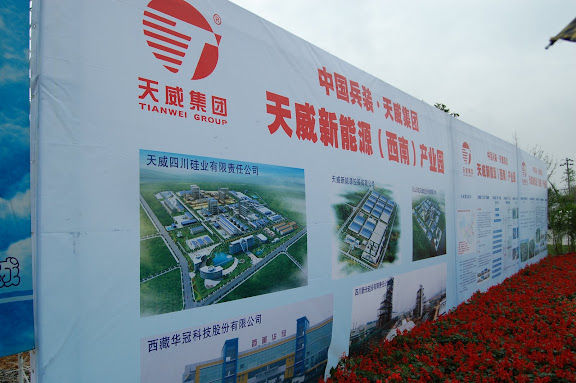
Some anchor companies at the industrial park include Tianwei New Energy Resources and Apollo Solar, both of which are taking vertically integrated approaches in developing their operations in Sichuan. Tianwei New Energy Resources Southwest Industry Park, a subsidiary of Tianwei Group, will channel some RMB 3 billion into building solar production facilities with a capacity of producing 200 MW of silicon ingots, 50 MW of solar modules and 100 MW of solar cells and a solar research center.

Another recurring theme of the conference was thin-film PV technologies. The solar industry as a whole has hitherto been anchored on silicon based technologies. The recent explosion of solar demand, however, has cause a short to medium term bottle neck on silicon feedstock supplies, providing a boon to so-called “thin-film” technologies which use little to no silicon. Apollo Solar is striving to be the foremost vertically integrated thin-film PV module manufacturer. The competitive advantage of Apollo is that it has mining rights to certain quarries such as Dashuigou (大水沟) and Majiagou (马家沟) within Sichuan province that gives them access key precious metals such as telluride, bismuth, indium, selenium and others that go into making thin-film modules. Some conference attendees told me that the rumor on the market is that it is Apollo which is providing First Solar, the world’s biggest think-film manufacturer based in Arizona, U.S., with its supply of these precious metals. A factory visit to Apollo’s plant revealed metals processing infrastructure and a think film module manufacturing line in place, but nary an employee in sight. Reportedly, operations are to commence this October.

Quantity AND Quality

Anthony Chia, Vice President of Quality Control at Trina Solar based in Changzhou, Jiangsu province, said at the conference that the way to set Chinese module manufacturers apart from the competition is through quality. Until recently, Chinese modules have suffered from an image problem of having lower quality. Although that has quelled somewhat with established Chinese brands such as Trina and Suntech Power gaining increased global market shares, Chia envisions a world market where it is Chinese, rather European or North American institutions that set quality certification standards. In a very real sense, China’s PV module industry is vulnerable to the whims of these quality certification bodies (or if one might dare read into it, protectionist measures to protect local PV industries). For example in Europe, it currently takes three to six months for newly developed module to be approved for sale by one of these quality certification bodies in the European market, explained Chia. Even minor amendments to certification criteria may threaten to extend the approval process to up to a year. The essence of Chia’s message is this: If China is going to be the world’s leading producer of PV modules, does it not also make sense for it to be the standard setter for quality certification? (I suppose critics might gripe against a potential conflicts-of-interest.)

Domestic Solar Adoption: A Chicken and the Egg Problem?

But I come back to the key issue of developing China’s domestic solar market. There is no doubt that China will have continued success in producing homegrown companies that have mastered the process of low-cost manufacturing and dominate the global PV manufacturing market. But rather than exporting all this clean energy, the Chinese solar industry should think about how it can take steps to develop the local solar market as well.

In my few months of talking to industry professionals, I have gotten the overwhelming sense that everyone is waiting for the government to enact the right policies to spur development. In turn, I have also gotten the sense that the government is waiting for the cost of solar (which in the US costs about 20 to 30 cents per kwh compared to 5 cents for coal-fired power) to drop before it goes all out to push the solar power in the same way it is pushing wind. But the price of solar is not going to achieve these dramatic cost reductions without a scaling up of solar technology deployment, and what better market (for sheerly physical reasons) to scale up solar than in China?

Here’s a preliminary policy prescription from The Green Leap Forward:

  • Enact feed-in-tariffs. The National Reform and Development Commission should promulgate comprehensive feed-in tariffs which require grid companies to purchase solar power at preferential tariff rates. These tariff premiums are to be fixed, but also gradually decreased over a period of, say, 20 years. As a possible "safety valve", these fixed tariff rates can be reexamined periodically to adjust for changing market conditions. The German government, for example, recently reevaluated the feed-in tariffs for solar. The premium that the grid company paid to solar power producers should be spread across all end-users, per the Renawable Energy Law of 2006. The hesitation of Chinese policy makers in adopting feed-in tariffs is something I hope to explore a little more in future posts.
  • Strengthen Solar Lobby. Chinese solar companies should actively lobby the government to push ahead with solar policy reform. It is to their advantage, afterall, to develop a broader customer base. The newly established New Energy Chamber of Commerce may provide an avenue for such activities.
  • Financial Innovation. Think about innovative ways of providing financing for solar installations. Given the early development of consumer credit in China, it may be some time before we can think of mass solar deployment in the residential sector, so continued advances along the credit front should be encouraged. For now, we should think about how third-party financing arrangements—whereby a facility engages another institution that installs and continues to own the solar panels, but sells the solar-generated electricity to the facility owner just like a utility, thereby relieving the user of prohibitive upfront costs of installing and owning the solar panels—can positively alter cost perceptions to solar power. Such third party financing institutions should target commercial and industrial entities, perhaps with the support of provincial and municipal governments which have energy efficiency and renewable energy goals to meet.
  • Technical Capacity Building. Develop the necessary capacity and technical expertise for all steps of the PV value chain, but especially for downstream solar activities such as systems integration, installation, and after-sales services such as performance monitoring and system repairs and upgrades. This will require significant investments in education, but also lead to significant positive externalities such as job creation and spill-over benefits to other electrical engineering sectors.
  • Government Procurement. Initiate mass procurement and deployment of PV in government facilities. Not only does the central government setting a right example work in China, but it provides a necessary starting point for the scaling up of PV deployment. The central government is large enough a bureaucracy after all.
  • Strategically Increase R&D. Much hype is generated whenever announcements on breakthroughs in PV conversion efficiencies or silicon wafer thickness are achieved. But there are plenty of cost reductions to be gained in other parts of the solar value chain. Increasing efficiency of polysilicon production, module assembly, balance-of-systems or even installation are all avenues that R&D dollars can be channeled to increase technological (and hence cost) breakthroughs.

These merely represent my initial thoughts on how to push to PV adoption agenda in China. What are your thoughts? Please leave a comment!

Sidebar: This piece in Renewable Energy World on China's PV industry focuses on polysilicon production.

Monday, June 30, 2008

Intel; GE; IBM; Nanosolar


Chipmaker Intel is the latest technology giant (after IBM and Applied Materials) to join the solar fray. It has spun-off its solar division to form an independent company called SpectraWatt that will manufacture crystalline silicon based solar cells. Neal Dikeman of CNet talks to the CEO of SpectraWatt about future prospects and the possibility vertical integration.

GE has increased its stake in PrimeStar Solar, a thin-film start-up relying on cadmium telluride technology (just like thin-film blue eyed boy, First Solar). While the use of cadmium causes some toxicity concerns, PrimteStar seeks to address these through its production policies. Separately, GE is teaming up with GAF Materials, North America's largest roofing company, to create "one-stop shopping for new roofs and solar electric systems." These are just the kind of strategic and innovative partnerships that can potentially help bring the transaction costs of installing roof-top solar systems down.

Speaking of IBM, the Big Blue continues its solar agenda by collaborating with Japanese manufacturer Tokyo Ohka Kogyo, a leading supplier of photoresists for semiconductor, flat panel display, printed wiring board and packaging, in CIGS (Copper-Indium-Gallium-Selenide)-based thin-film technologies. According to the press release, it aims to develop cells with 15% conversion efficiencies compared the to the 11 to 12% efficiencies available in the best commercially available thin-films cells today.

As if in response to IBM's announcement, NanoSolar released some truly astonishing footage of its its new "nanoparticle ink" press, a $1.65 billion 1-GW-per-year tool capable of coating 100 feet-per-minute of CIGS material that has a 14% efficiency. This is significant news for several reasons. First, most production tools in the solar indnustry have production capacities of only 10-30 MW annually. Second, solar cell efficiencies of 14% represent an improvement over what is commercially available today. Third, the company claims that 100 feet-per-minute is just a start, and that 2,000 feet-per-minute is possible! See also this piece by GreenTech Media for a the potential cost-breakthroughs that this annoucnement represents. Previously, the company also announced that it has a "fabulous" plan for serving the residential roof-top market. If all that the company claims is true, I wouldn't bet against this Google-backed startup (technically backed by Google's founders Larry Page and Sergey Brin, rather than Google itself) when they IPO.

Wednesday, June 11, 2008

Micro-inverters…Lots of Them

Enphase Energy spoke with the solar coaster about their groundbreaking micro-inverter system technology.

Many solar PV breakthroughs have been achieved by increasing solar conversion efficiencies of solar cells. One of the themes I have previously touched on in achieving grid parity solar power is the reduction of the balance of systems and installations costs. In Enphase Energy’s Micro-inverter system, launched yesterday, we might just be seeing a significant breakthrough in increasing solar system efficiency (which is really what matters, rather than just solar cell efficiency).

The Single Large or Several Small (SLOSS) debate is a well-known battle of ideas in the field of conservation biology. Enphase is seeking to prove that when in comes to solar power inverters, there is no debate, and that several small is the way to go.

An inverter is a necessary component of any solar system. It converts the direct current (DC) generated from a PV system into alternating current (AC) to make it compatible with the grid and usage of electrical appliances. Typically, a solar installation will rely on a single large inverter. With Enphase’s novel Micro-inverter System, each solar panel gets its own micro-inverter. Each micro-inverter is connected to a communications gateway that feeds solar power generation data to a monitoring data center that can be assessed by the solar user by the internet. Check out this cool video which take a closer look at the micro-inverters and how they are installed.

The Micro-inverters represent a remarkable technological advancement for a variety of reasons:

  1. Increased energy harvest—According to Enphase’s CEO, Paul Nahi, its 1,000 or so pilot Micro-inverter systems currently deployed have experienced a 5 to 25% increase in energy harvest over traditional single inverter systems. The reason is two-fold. First, its inverters are the first to achieve 94.5% inversion efficiency. Second, and perhaps more significantly, the phenomenon where multiple solar panels arranged in series and connected to a single large inverter perform only as well as the worst performing solar panel is avoided. Because each panel now has its one micro-inverter, a poorly-performing panel (for whatever reason such as shade or damage) will not affect the efficiency of the other panels.

  1. Increased reliability—The obvious advantage to having “several small” over “single large” is that the system is no longer vulnerable to the failure of the single large inverter. Additionally, Enphase’s Micro-inverters have a MBTF (mean time before failure) of 119 years, as compared to 15-20 years of regular large inverters. Another dimension to increased system reliability is that because each panel now has its own inverter feeding data to the monitoring center, a user is now able to, in the event of suboptimal performance, pinpoint the malfunctioning panel by acessing such data on the internet through Enphase's web-based monitoring software (see screenshot on right showing panel by panel performance data of a typical solar array) and resolve the problem more promptly.

  1. Increased ease of installation—Enphase’s Micro-inverter system radically simplifies the installation process by eliminating installation complexities (e.g. string design, marginal designs, co-planarity, and matched modules) associated with installing a high voltage inverter. There is no need to make space for a large centralized inverter and wiring time is reduced. The result, says Nahi, is that the balance-of-systems costs can be reduced by 13 to 15% by using Enphase’s systems.

All this means is that the return on investment in a solar system is greatly enhanced in multiple ways, and none of them have to do with increasing solar cell technology. According to Nahi, not only are there life cycle savings to the Enphase Micro-inverter system, but the up-front economics of the system also compare favorably to traditional single inverter systems.

Enphase has raised $6.5 million since its inception in 2006 from investors such as Third Point Management and Applied Ventures. According to Greentech Media, Enphase is selling its products and services through installers and distributors such as AEE Solar, DC Power Systems, Focused Energy, Solar Depot and SunWize.

Balance of system and installation breakthroughs are just the kind of stories I’d like to focus more on. As this excellent article on Enphase’s corporate background observes:

In the fast-growing solar industry, most of the venture capital to date has flowed into developing newer and better photovoltaic cells, while the inverter has largely been overlooked, Nahi said. "There are all kinds of new panels coming out . . . and it's thrilling to watch," he said. "But very little investment has been made in the inverter space."

Hopefully, this new technology byEnphase and the news by Xantrex that is has received $1.9 million in orders from OptiSolar are signs of change.

Tuesday, June 3, 2008

Impending pSi oversupply; Masdar big on thin-film; Reprieve in Germany

Polysilicon

Kyocera announced innovations in reducing thickness for multicrystalline silicon-based cells, leading to more efficient consumption of polysilicon, the raw ingredient that is currently experiencing a short-to-medium term supply bottleneck. Gunther Portfolio reports of a company called Schmid Silicon Technology that has developed an alternative process to the conventional Siemens process of polysilicon manufacturing called the UMOSI process, which supposedly has a cost structure that is 28% cheaper.

There are signs that the bottleneck will ease soon, however. Michigan-based Hemlock Semiconductor is ramping up production as its new facilities come on line and will double polysilicon production this year and will produce 46,000 tons by 2012. An affiliate of China-based PV manufacturer, Yingli Green Energy, is also exploring a move up the solar value chain to produce 3,000 tons of polysilicon annually. In fact, the Prometheus Institute warns that a worse-than-expected oversupply of polysilicon is impending.

Thin Film

I would think that an oversupply of polysilicon is good news for installers of silicon-based PV solar panels, and a less favorable proposition to thin-film PV producers, which have built their current competitive advantage on the fact that they use less polysilicon. However, the Prometheus Institute believes that advances in technology will help the thin-film industry continue to thrive as production grows from 1GW this year to 9 GW in 2012. One observer attributes this to the barriers to entry in an industry that is dominated by handful of large players like First Solar.

Another “big player” is the government of Abu Dhabi. More specifically, the government-owned Abu Dhabi Future Energy Co., as part of its Masdar Initiative and Masdar City plans, has contracted Applied Materials to build three SunFab Thin-Film lines with 210 MW of capacity. This $600 million contract is part of a $2 billion initiative to start a world class thin-film development company (see press release).


Big Solar

Some notable joint projects for utility-scale solar plants in the U.S. announced recently include eSolar and Southern California Edison’s plants totaling 245 MW in the Antelope Valley of Southern California; and Duke Energy and SunEdison’s PPA to build a 16 MW solar plant in Davidson County, North Carolina that will be the largest PV array in the country at the time of construction.

Policy

The entire solar industry heaved a collective sigh of relief when an agreement to reduce feed-in tariffs for solar power in Germany by up to 10% instead of 25-30% as urged by opposers of the subsidy was reached among German policymakers. On the China front, it is reported that the central government will soon release policies to stimulate domestic adoption of solar power. Currently, more than 90% of solar modules produces in China are exported.

Corporate and Industry Trends

German auto-parts manufacturing giant Bosch is to aquire 50.45% of PV-maker Ersol, valuing the company at just over EUR 1 billion. Greentech Media asks whether this is a fair price and notes that this could be a start of a trend of large engineering and manufacturing firms seeking to diversify their holdings as valuations for silicon-based PV producers decline as polysilicon goes into oversupply.

Meanwhile, South Korea seems to be ramping up its solar industry with reports like this and this.

And to end this post on a sunny note, solar optimist and futurist Ray Kurzweil predicts solar will be competitive with fossil fuel energy in five years.

Impending pSi oversupply; Masadar big on thin-film; Reprieve in Germany

Polysilicon

Kyocera announced innovations in reducing thickness for multicrystalline silicon-based cells, leading to more efficient consumption of polysilicon, the raw ingredient that is currently experiencing a short-to-medium term supply bottleneck. Gunther Portfolio reports of a company called Schmid Silicon Technology that has developed an alternative process to the conventional Siemens process of polysilicon manufacturing called the UMOSI process, which supposedly has a cost structure that is 28% cheaper.

There are signs that the bottleneck will ease soon, however. Michigan-based Hemlock Semiconductor is ramping up production as its new facilities come on line and will double polysilicon production this year and will produce 46,000 tons by 2012. An affiliate of China-based solar manufacturer, Yingli Green Energy, is also exploring a move up the solar value chain to produce 3,000 tons of polysilicon annually. In fact, the Prometheus Institute warns that a worse-than-expected oversupply of polysilicon is impending.

Thin Film

I would think that an oversupply of polysilicon is good news for installers of silicon-based PV solar panels, and a less favorable proposition to thin-film PV producers, which have built their current competitive advantage on the fact that they use less polysilicon. However, the Prometheus Institute believes that advances in technology will help the thin-film industry continue to thrive as production grows from 1GW this year to 9 GW in 2012. One observer attributes this to the barriers to entry in an industry that is dominated by handful of large players like First Solar.

Another “big player” is the government of Abu Dhabi. More specifically, the government-owned Abu Dhabi Future Energy Co., as part of its Masdar Initiative, has contracted Applied Materials to build three SunFab Thin-Film lines with 210 MW of capacity. This $600 million contract is part of a $2 billion initiative to start a world class thin-film development company (see press release).

Big Solar

Some notable joint projects for utility-scale solar plants in the U.S. announced recently include eSolar and Southern California Edison’s plants totaling 245 MW in the Antelope Valley of Southern California; and Duke Energy and SunEdison’s PPA to build a 16 MW solar plant in Davidson County, North Carolina that will be the largest PV array in the country at the time of construction.

Policy

The entire solar industry heaved a collective sigh of relief when an agreement to reduce feed-in tariffs for solar power in Germany by up to 10% instead of 25-30% as urged by opposers of the subsidy was reached among German policymakers. On the China front, it is reported that the central government will soon release policies to stimulate domestic adoption of solar power. Currently, more than 90% of solar modules produces in China are exported.

Corporate and Industry Trends

German auto-parts manufacturing giant Bosch is to aquire 50.45% of PV-maker Ersol, valuing the company at just over EUR 1 billion. Greentech Media asks whether this is a fair price and notes that this could be a start of a trend of large engineering and manufacturing firms seeking to diversify their holdings as valuations for silicon-based PV producers decline as polysilicon goes into oversupply.

Meanwhile, South Korea seems to be ramping up its solar industry with reports like this and this.

And to end this post on a sunny note, solar optimist and futurist Ray Kurzwel predicts solar will be competitive with fossil fuel energy in five years.

Friday, May 23, 2008

Happy Birthday, solar coaster!!!

the solar coaster turns one year old today!

Here's the birthday wish list:

For its birthday, the solar coaster wishes that over the next year, governments round the world adopt progressive policies promoting solar power and other renewables, such as feed-in tariffs and net metering, and increase allocation of public funding to basic R&D in the renewables sector.

At the same time, the solar coaster also wishes that research labs and solar companies the globe over continue to make headway in reducing the cost of solar, not just by improving solar conversion efficiencies but also by reducing costs in balance-of-systems, in addition to non-technological (i.e. installation, financing, interconnection, etc.) aspects.

Finally, the solar coaster hopes that solar energy is further able to contribute to the poverty alleviation causes in the developing world, but delivering energy to remote rural areas not connected to electricity grids.

the solar coaster has been proud to bring solar news and analysis for the past twelve months, and looks forward to another twelve and many more ahead!

Thursday, May 22, 2008

SunPower and IBM Claim Higher Efficiencies; DuPont Enters Thin Film Market

SunPower Reaches 23.4% Cell Efficiency
SunPower Corporation announced that it has produced a full-scale, five-inch prototype solar cell with an efficiency of 23.4%. This is a world-record for a large area solar cell according to the company.

IBM Also Claims Major Boost in Solar Cell Efficiency...
IBM has managed to squeeze 230W of power on to a centimeter square of solar panel using concentrator photovoltaics. The energy was then converted to 70W of usable electric power, the best power efficiency yet achieved, the company claims.

...and Replants Chip-Cooling Tech in Solar Farms
IBM has developed technology that will let solar cells withstand the heat of more than a 1,000 suns...representatives from IBM Research's photovoltaics research will present a method for cooling concentrating photovoltaics, a solar design where light is magnified onto high-performance solar cells.

DuPoint to Enter Thin Film Amorphous Silicon Market
DuPont (NYSE: DD) announced that it will soon begin construction on a research center in Hong Kong and a manufacturing facility in Shenzhen to support the rapidly growing photovoltaic (PV) solar energy industry

India May Set Up Solar Energy Commission
The Centre proposes to set up a Solar Energy Commission, with equal participation from the private sector. It is to tap the solar energy potential for meeting the future energy needs of the country.The initial investment for the project will be around $ 10 billion.

Barriers to Solar Energy's Blockbuster Promise

Green Tech Blog reflects on what is holding back the solar explosion in California.

Fun Solar Tech of the Month: Solar Lilypads!